araptirop

An extended backpacking jaunt around Ethiopia.

My Photo
Name:
Location: Washington, DC, United States

I lead a rich inner life, appreciate a good marshmallow, and have been known to indulge in the occasional Wednesday afternoon tryst underneath the linden tree. I am currently between extended trips to East Africa; this is my story.

17 April 2007

From Kabale to Kisoro

Uganda, Rwanda and DRC (sort of)

Lake Bunyonyi proved to be a most halcyon retreat. Beth, Lauren and I spent four days sharing a rustic cabin, gorging ourselves on the outstanding food, and relaxing over a growing army of empty beer bottles. I passed the days reading volumes from Boonya Amagara’s extensive library, awkwardly coexisting with the other backpakers, and drilling the wonderfully informative Beth on the legal minutiae of Limited Liability Companies (LLCs to the layperson).

Things did get a little strange now and then. Beth and Lauren were fast approaching a toxic saturation level of Larium, the malarial prophylactic notorious for provoking deranged dreams and psychiatric disorders. The first time I visited Africa, I had taken Larium only to notice a strange spike in the significance of colors and a multiplying pixelization of my visual field. I switched to Malarone which instead of disturbing my labile brain diminished my bank account.

Given the general onset of Gothic horror attending protracted Larium use, the cabin was ill-suited for the girls—especially Lauren and her personality’s mixture of OCD and arachnophobic qualities. In other words, the cabin was absolutely infested with spiders. The amount of spiders crawling, spinning webs and slowly descending into Lauren’s hair was truly remarkable. On Monday, the day after the afeared ‘Larium Day’, I spent the evening bravely dispatching spider after spider to insect limbo while Lauren trembled inconsolably. My valiant efforts came to aught. The foes were simply too many for me.

Lauren took solace in her dwindling supply of unnamed Tanzanian spirits. I busied myself walking around the grounds of Boonya Amagara. If you’re ever in Uganda, you should really make an effort to visit this not-for-proft organization. Otters swim backstroke in the lake, strange birds call mellifluously from the trees, and Jason—the American coordinator—huddles behind the desk scoping out the internet and nursing the contents of ‘the Box’. It’s a scrupulously eco-friendly place with composting toilets, locally fashioned furnishings, and a wonderfully competent staff. The food is among the best I’ve had in Africa; the profits are all re-invested in the community (which has access to the library and computer lab); the location is stunning and tranquil. It’s basically a workable utopia—not to mention fantastically cheap. I wondered why nothing of the sort had been attempted in Ethiopia where every tourist hotel seems curiously indifferent—even downright hostile—to the local community.

Not much of note happened, the true measure of Byoona Amagara’s pleasant remoteness. My admiration for Lauren and Beth grew steadily until we parted ways. They headed back to Kampala en route to Cairo. I was westward bound trying to see Rwanda and the Congo. I hugged them with unusual warmth as they boarded the bus. They were really good friends.

On the road from Kabale to Kisoro, the earth undulated into clusters of green hills. Some of the vegetation was so green and rinsed in the sun that it appeared an iridescent blue. Prodigiously rumped women busied themselves in the agricultural plots, slamming hoes into upturned soil, some with slumbering children cradled on their backs in kangas. I was headed to Mgahinga National Park on the border of Uganda, Rwanda and Congo. As the bus swayed its way into Kisoro, the cloud strewn-peaks of the Virunga volcanoes came into view.

I spent the night in Kisroro and got things together for some mountain hiking in Mgahinga, the densely forested habitat of one of the world’s last troops of mountain gorillas. As the taxi belched along a horrendous 14 kilometer stretch of road to the park gates, I saw a small girls’ school with this heartening scrawl smeared across it: “Moving alone is not safe. You could be defiled.” Indeed, this part of Uganda had been the site of some terrifying fall out from the civil war in neighboring Congo. A couple of years back, the self-styled Mai Mai militia—noted for its espousal of cannibalism, wanton slaughter and other nihilistic delights—had crossed the border at Bunagana and wreaked havoc on the hapless country folk. As anyone conversant with reports from the many NGOs in the area knows, rape had been widely used as a weapon of war to devastating effect. I was assured that there was no longer any danger—the UN had driven the rebels back into the jungles, and the Mai Mai leader was now part of the DRC’S power-sharing government.

I arrived at Mgahinga Community Camp, another model community-oriented tourism initiative, and began pitching my tent. While struggling with the poles, a brunette Swedish woman walked out of one of the bandas, looked at me with a blasé expression, and threw back a swig of water.

“Hello,” I offered with a smile.
She glared at me cooly, turned around and walked back inside.

I learned later that her name was Louise and that she was studying the local Batwa community known more commonly—and pejoratively—as pygmies. Improbably for an agrarian backwater in southwest Uganda, Kisoro was literally crawling with bonny Swedish women in the early-twenties age bracket. They were there taking part in some sort of government-sponsored school program. I started wishing I was Swedish.

I found what I thought was an outdoor urinal, a wall of thatch enclosing a couple of bricks and apprehensively used it. After four days of camping at the MCC and
pissing in the same place, I still didn't know if it was a urinal. But my transgressive urination aside, I did spend four magnificent days in and around the
the park.

More on that soon.

Labels:


30 March 2007

We Rafiki Three & Lake Bunyonyi

We awoke early, terribly early, and took a taxi to the Post Office. In Uganda, the Post Bus is perhaps the only mode of transportation reliably short on near-death experiences. One regularly plied the road to Kabale, our drop-off point for a jaunt to Lake Bunyonyi. We were excited; the lake was purportedly free of bilharzia and situated in a cool climes. After three months of siphoning Ethiopia’s Biblical suffering, the quiet lapping of a high-altitude tarn sounded deliciously inviting.

We sat around in a maze of paint-chipped P.O. boxes as the city’s sallow haze lifted and the sun peered over the skyline. When the time came, someone would ostensibly direct us to the bus. As I sat nodding off on the belly of my backpack, a middle-aged man with a curly shock of whitening hair climbed out of a taxi. We began to chew the fat. He was going to Gulu to work on some species of academic work.

“I used to study African History at Madison,” I offered.
“Oh, and who are you,” he crooned.
He asked the question with such a nauseatingly cloying intonation that I had to check my gag reflex. I glanced at Lauren and Beth, seeing both of them shudder. What did he expect me to say? “I am Dr. Wanker McShithead,” passed through my mind, but instead I said, “My name is Dallas. I’m nobody.”

He quickly lost interest after oozing out his name, first and last, and turned to Lauren and Beth. “And what about you?” Lauren gave him a short, standoffish bio. Beth told him she was going to law school. “Mmmm,” he purred, “and what school are you going to?”

“Harvard.”
“Oh.”

That shut him up. His school was a few ratchets down the academic totem pole. I attempted to make further conversation, but once I admitted that I was unfamiliar with his work, his face, which had the self-conscious mold of somebody perpetually peeking in a mirror, began to tune out. We had some mutual acquaintances, and just as I began to talk of my professor who specialized in pre-colonial Buganda, he turned away from me mid-sentence.

A slender man dressed incongruously, for Africa, in an effeminately striped form-clinging shirt and jet black tapering trousers sashayed over to Dr. Wanker and initiated a ritual of schmooze. He sported a ruthlessly manicured mustache set off against the cadaverous white of his upper lip, an eyelash-thin strip of wispy fuzz that he caressed lewdly as he talked. He was a bizarre sight for this part of the world. All in all, he looked like a hybrid of Eurotrash and professional pederast. He extolled Dr. Wanker on the strength of a recent paper. The academic hero’s head grooved smugly to the tune of his deification. It was appalling; the whole thing reminded me of the gay bar pick-up scene in Traffic.

We split ways, I absolutely thrilled at my abysmal failure in the hallowed halls of academia. It helped me remember why I was always so depressed at University. I was glad that I would never have to act as if I held either of them in esteem.

We were misdirected until we finally happened upon the bus to Kabale and pulled out of the lot. I can’t give much in the way of scenery because my only moments of consciousness involved the splashing of drool on my hand and one embarrassing jolt during a nightmare about insects. My entire spasm was watched with bemused detachment by Beth.

“Sorry, I thought I was covered with bugs.”
“It’s okay,” she returned. “After three months in Ethiopia, I can only imagine there would be bugs in your dream world.” (Not verbatim--Ed.)

After seven hours of drooling and several stops wherein roadside hawkers jabbed spears of rancid nyama choma through the window, the bus finally trundled into a rain-soaked Kabale. We disembarked to the raucous solicitations of sundry taxi drivers. The girls had reserved a car through Byoona Amagara that was supposed to convey us to the boat launch. Unfortunately, for us, every driver claimed that he was Dennis the driver, not one of the half-dozen impostors. To make matters worse, each claimed that he had come to pick up ‘Monica.’

“You are Monica?” one of the men asked me.
“Yes, despite appearances, I am a full-blooded woman inside.”
“Who sent you?” Lauren countered.
“I sent myself!”
Wrong answer.

At length, we decided on the most insistent Dennis who quoted the same price that the girls had been emailed. He was an affable enough fellow, and the months of travel had deranged me enough that I deemed myself capable of gallant violence should he try to hold us for ransom or whatever people worry strangers will do to them in Africa. We dragged our bags into the car and began lurching through pot-hole puddles.

I had noticed a couple words of Swahili in the hubbub of and decided to bounce some sentences off Dennis.

“Unasema Kiswahili?”
“Yes!”
“Kuna majira ya mvua sasa? It’s the rainy season now?”
“Yes! I must pick up some pineapples!”
The girls snickered at the non sequitur. I fell silent.

We pulled into a sorely pockmarked road where we indeed picked up some pineapples and moved on.

“We have very bad drought here,” Dennis said motioning toward the farmland. Was he out of his mind? The congestion of vegetation was spilling from leafy hillsides onto the road. An Ethiopian drought and Ugandan drought were evidently two very different things. Uganda, so far, had been eminently more arable than Ethiopia where gray dust was the general farming medium. Here, banana trees flourished in eruptions of green propellers, avocados hung heavily from trees, and rich red mounds of soil teemed with young vegetables. Plus it was raining.

We pulled up to pier where we were greeted by a phalanx of dock workers. I ducked into a drop toilet whose previous users were apparently unfamiliar with the concept of aiming. When I returned to the launch, a dopey-faced madman in raggedy wardrobe appeared ex nihilo and performed a sad, bow-legged dance without the benefit of rhythm. He then asked me for a cigarette. I made the mistake of giving him one. This launched another inscrutable series of dancing movements punctuated by the aimless jabs of his walking stick. After his second disquieting performance, he rattled on about how much he loved to dance.

“I am dancing! I am dancing!”

Then, of course, he asked me for money. I denied him remuneration for the spectacle of debasement. He grew quiet and sidled up to me conspiratorially, nodding toward an African woman standing a couple of feet away.

“You want?” he asked brandishing his walking stick.
“What?”
“You can!” he yelled as he began to pantomime beating the woman with the stick.
“You beat her? You shouldn’t beat her.”
“No, no, no!” he returned indignantly. “But you…” and he recommenced his stick-beating charade.
“You think I should beat her?” He nodded eagerly.
“Why would I want to beat her? Besides, it was International Women’s Day two days ago. I don’t think it’s really in the spirit of the holiday.”
He gave up this course and began pursuing another, again in reference to the hapless African woman. He put his fist to his mouth and made the universal fellatio sign in a display much more graphic than it needed to be.
“No,” I said to his slurping. “I don’t need that.”
He looked dejected. Then he asked, “You have friend?”
“Yes, I have two friends,” I said pointing to the girls. They had detached themselves from the pageant as soon as it began.
“Hawa ni rafiki zangu.”
“Rafiki?” he said salaciously.
“Ndiyo, rafiki wa tatu, sote.” Three friends, all of us.
“Rafiki?” he muttered in amazement.
Lauren looked over to him and said, “Yes, all of us rafiki.”
At this the madman burst into a teary-eyed joy, his arms outstretched in triumph. “All three of you rafiking!”
“Yes,” Beth replied, “we are rafiki.”
“F--ing! You three f--ing!” he blurted out.
“Yes, we are rafiki…” I began with hesitation. “Are you saying rafiki or…”

But it was too late. He slapped me on the back, waved his arms in the air, and capered around the launch point in a state of euphoric delirium. I turned to the girls, both of whom were averse to idea on some pretty intransigent principles, and sighed,

“I think rafiki became f------g.”

Labels:


25 March 2007

News Flash!

My traveling companions of one week are writing about our experiences on their blog! It's weird to see me detached from my own keyboard. Anyway, you can see how much hyperbole is involved in my writing by cross-checking it with theirs.

Girlsgoneworldwide.com (click it)

(not to be confused with GirlsGoneWild)

Labels:


From Ethiopia to Uganda...By Air!

Coming from Ethiopia, Uganda looked green—obscenely green. The watercourses of Southern Ethiopia were parched dry. From the airplane above, I could see only the claw marks of sunken waters, riverbeds without rivers. This began to change when we entered Ugandan air space. Immediately, a handful of forested mountains rose from the lowlands. As we grew closer to Kampala, neatly terraced hillsides popped up, growing in frequency until they outnumbered the patches of scrub. By the time we circled around Entebbe National Airport, the world below had matured into a rich carpet of red soil and luminous verdure.

I had been informed by a Ugandan sitting next to me that, compared to Ethiopia, Uganda was unencumbered by bureaucracy. I rejoiced at the prospect. The bureaucratic morass in Ethiopia had been truly unbelievable. You can’t give a birr to a beggar without having to wait for a receipt. My parting memory of the country was an abortive attempt to get a police report for my stolen camera. I went to the Mercato police station where I was shifted between four different offices and mistakenly taken to jail. There an unusually jubilant mob of prisoners greeted me with hoots and howls. Everyone wanted my mobile number.

After an hour or so of acquainting myself with every inch of the station, an English-speaking policeman wrote down everything I told him in Amharic. Then he did this again on a more ‘official’ form. After two hours of this, he informed me that it was forbidden for him to write in English and explained that I had to go to the main station near St. George’s Church. There, he said, I would be given a form to take to the U.S. Embassy where I would receive another form to return to the police station. Then, apparently, something would happen. He estimated the entire process would take three days. In any case, the form for the main station took another hour to write up. I left Ethiopia with about one-eighth of the undertaking complete.

My Ugandan visa took no more than two minutes; my Ethiopian one had taken no less than one hundred. Perhaps what I heard through the grapevine was true: Uganda is an easy country to travel in. I walked out of the terminal in high spirits. Having mastered fidel, the Ethiopian alphabet, and perfected the pronunciation of Amharic’s glottal consonants only to run into a brick wall when it came to verb conjugation, I was anxious to flex some of my Swahili. I encountered a taxi driver as I exited the terminal and decided to start right away.

“Hujambo bwana?”

He looked at me like I was retarded. I learned quickly that Kampalans, for the most part, eschewed Swahili in favor of Luganda. They also drove at speeds unfathomable for Ethiopia. As the taxi hummed along at 120 km an hour past bicycles and purring motorcycles, Entebbe gave way to Kampala. During three days in Uganda’s capital city, I noticed several tangible differences from my beloved Addis Abeba.

First of all, the cityfolk didn’t convulse into abject hysteria at the sight of an mzungu. I felt a bit let down at the lack of throngs and screaming children. Indeed, I felt like I had gone from being Brad Pitt to Dallas Lillich in a matter of hours. Secondly, Kampalans were glaringly free of disease. They seemed, on the whole, in much better shape than Ethiopians, many of whom suffer from creepy eye diseases and ringworm issues. Moreover, I didn’t see a single leper or unfortunate on the verge of starvation. But despite these happy absences, I found Kampala to be a much less walkable city than Addis. My difficulty in getting around probably owed as much to my tenderfoot status as it did to the hill density; less ambiguous was the constant stream of screaming cars at every intersection where I invariably waited for five minutes before hurtling myself kamikaze-style into traffic. At least, it seemed, Kampalans were aware that walking obliviously in the road was insalubrious.

I checked into the Red Chilli Hideaway which had been recommended to me by a number of people. They only had self-contained cabins available for $30. I had some extra money from leeching off of Hannah Maryam for two months, and I desired something like comfort—a condition I couldn’t find in Ethiopia in the $20-$30 range. (The ‘nice’ hotels I stayed in when I was sick always seemed to have a throbbing club scene directly underneath my room and a major surplus of gap-toothed whores.) I was dead-tired from staying up all night eating chat with Meki and wanted to sleep, so I committed myself to the expense.

The amiable guy at the desk walked me to the room. We chatted in Swahili on the way. I ended up completely confounding him because half the words came out in Amharic. As we neared the cabin, it looked preposterously large. “This is all mine?” I asked. He nodded, opening the door.

At first sight I was completely awestruck. I had in my possession not a mere room, but a fully functional babe lair. There were three overstuffed couches, a mahogany dinner table with candelabrum (and candles), silky curtains rippling from capacious windows, a double bed, bathtub and en-suite bathroom with—gasp—toilet paper! “Are you sure this is 60,000 shillings?” He told me it was and left. I walked around the cabin akimbo a couple of times and then passed out face down.

I awoke submerged in a tremendous puddle of drool. I rolled over, disentangled myself form the mosquito net, and walked to the on-site restaurant and bar in search of recruits for the babe lair. Upon entering the premises, the guy at the desk told me that a girl by the name of Lauren had noticed my name in the guestbook. “She knows you,” he said. “She went to the same school as you!” I neglected to remember that I’d signed my address as ‘University of Wisconsin-Madison’ and began entertaining thoughts of a pulchritudinous secret admirer. Perhaps she knew me from my band Johnny and the Church Camp Rebels and was trembling in the presence of a bona fide lady-killer. The name Lauren rang sonorously in my mind conjuring up unlikely visions of an exotic beauty wholly devoted to my every whim. I suppose I was pretty lonely. In this way I sat around drinking until I noticed a comely young woman with a wireless card sticking out of her laptop.

“Excuse me,” I said suavely as she passed by. “Do they have wireless here?” “No,” she said wistfully and a conversation was born. Before long she told me that Lauren, her girlfriend, had seen that I was from Madison where she had gotten her B.A. And so, as is often the case with me, the spider had not caught a fly but instead idiotically entwined itself in its own web.

This ended up being just fine, as I made two fascinating new friends whom I bored with my endless blathering about the ex-girlfriend who I clearly hadn’t sweated out of my system. They also had with them a large supply of Tanzanian swill, a resource that I exploited into extinction. Lauren was a documentary filmmaker with a history of NGO work; Beth was a young New Yorker politico on her way to Harvard Law. They were traveling around the world for a year before returning to their sure-fire, power-couple existence on the eastern seaboard. They moved into the babe lair with me for two nights wherein the most erotically-charged moment ended up being my early-morning sighting of Beth’s bare back.

We got our plans together for an excursion to Lake Bunyonyi and had some excellent conversations in which Lauren gleaned a number of regrettable quotes from me for their website’s exhaustive ‘Quotes’ section. I seem to remember saying something alone the lines of “The Qu’ran isn’t very chill.” (See girlsgoneworldwide.com for the incriminating evidence.) We spent a couple of days in Kampala before boarding a bus to Kabale en route to four days of easygoing eating, reading and sleeping on Itambira island.

Labels:


03 March 2007

Update Uganda

Wow.

The outpouring of comments from that last entry has lit a fire underneath my chapped backside. I would feel guilty if I didn't tell all a yall what changes I'm making to my plans. I didn't think anyone even read this old thing.

Some species of parasite has amorous feelings for me. I can't kick it. After finishing the antibiotics, I started strutting around like the cat's pajamas. I was flexing in the mirror, ruminating on chat, high-fiving everyone. Then, one night, that surly brown foe began roaring in my entrails again. The last three days have been a lesson in aiming a shower head's flow of sewage into the meager opening of Meki's drop toilet. So, even if I haven't left the homestead for a couple days, I've been pretty occupied.

Anyway, given my advanced decrepitude, I've decided that Northern Kenya isn't the best idea. I can't imagine traveling through such harsh territory with total gut rot. I hear great things about Uganda all around, so I'm going to try to take a flight to Kampala and see the 'Pearl of Africa.' I'll meander around, perhaps breach the border with Rwanda. It all depends on whether I can, in fact, recover.

After that, I'm planning on returning to Ethiopia and opening up an antiquities venture with Meki. It's too good an opportunity too pass up--roving the bush, having a permanent base camp in Africa, traveling the globe with my web catalog of goods--not to mention bedding jewel-eyed maidens the world over. I'll keep people posted on how that comes along.

For now, I have a treasury of photos from Northern Ethiopia that I'll upload as soon as I have them organized on my laptop and can find something approaching broadband (a word with an utterly different connotation in Ethiopia). This Flickr/Blogger slide show hybrid is pretty cumbersome, so the photos might end up linking to a .Mac page gallery. To those of you who have mentioned publishing, I have been working on what could only be called an experimental travel novel set in Africa. It has to be just about the weirdest travel literature I've ever read. The first three chapters are in development; the first one I've nearly finished--bizarre. Sort of like a Mevillean invocation of the muse. It's coming along, maybe I'll put some of the chapters on here.

I'll keep working on this blog. If nobody objects, I'll start posting entries without regard to chronology. Thanks for the support, everybody. It really does mean something over here. Keep putting up comments and I'll keep posting.

I have to go to the bathroom.

Labels:


28 February 2007

The State of the Dallas

To my loyal readers:

The last month or so has been action-packed with epic battles of will. To those of you who have been kind enough to inquire about my well-being, I’m please to report that it is back, after something of a rough patch. Once in Lalibela, I acquired what I think may have been dengue fever but was just as likely a monstrous case of the flu. As my last entry indicates, I recuperated in Gondar just long enough to get myself nearly stoned to death. From there I made my way to the Simien Mountains where I again encountered adventures in stone throwing, was mauled by a mule and plagued by a case of what may best be called heinous anus with supplementary vomit.

I alighted in Aksum after a sweltering day in the cab of an Isuzu and enjoyed my time there as much as I could in the circumstances, which were darkened by an unforeseen visa deadline owing to the ineptitude of a petty clerk. Once the airline servers were back on-line, I sullenly flew back to Addis to renew my visa. Whilst there, I began to get my bearings back a bit and feel the faint stirrings of confidence. I moved back in with Hassan, my macchiato brother, only to find him in the middle of a religious revival. The hut had been converted into a Muslim prayer center. I tried to keep the beer bottles from clinking during the homage to Allah and finally quit drinking altogether.

Together we made a pilgrimage to the Wolkite area of Gurage-land, the land of his birth. It was a revelatory and inspiring experience that I hope to address in a later entry. My wholesale eating and drinking of questionable fare continue, and by the time we returned to Addis, I felt a bit rearranged. The next morning I was awoken by a thunderous burst of intestinal purée and absconded to a hotel. I spent three days there dodging the advances of enterprising hookers, reading the Qu’ran and The Portrait of the Artist as a Young Man, and attending to the ministrations of my dyspeptic bowels. As the bell continued to toll, I finally made it to a clinic where the jolly doctor informed me that I was hosting a gala of dysentery, Guardia and hookworm. The hookworm came as a surprise and something of an insight. I’d spent a number of hours laundering everything amenable to soap, thinking that the scabrous welts on my legs were evidence of fleas. This was not the case; they were the staging-grounds of a hookworm fleet burrowing its way to my innards.

I’ve finished my course of antibiotics and also received my laptop, a maddening process worthy of Kafka novel. I intend to get to work straight away. The dreary and excruciatingly slow Internet cafes need not delay me anymore. My camera, however, is in a state of disrepair, so mere words will have to suffice for a month or so.

I’m leaving Addis and lumbering south in a couple days. My visa is again a cause of worry, so I’ll have to see Ethiopia’s nether-regions on my way back. For now I’m focusing on the desert regions of Northern Kenya. I hope to make it from the montane oasis of Marsabit to the jade seas of Lake Turkana. This is in the Northern Frontier District, a name that suggests a paucity of web access. Whatever happens, we’ll meet again in the foothills of Mount Kenya. I’ll continue forging ahead on my laptop and updating the blog haphazardly for now. Wish me luck.

Peace!

Labels:


15 January 2007

The Stoning Begins Now

I've been a bit backlogged on my posts and placing the blame on the exorbitant cost of Lalibela's Internet cafes and a nasty case of the flu. I've been trying to fill in the lacunae chronologically, but last night I had an experience that begs relation while freshly plowed in my mind.

I can say, even conservatively, that I have never been so thoroughly in the cross-hairs of danger; nor have I ever been party to so bloody a fracas.

So fast-forward: I'm convalescing in Gondar, the site of a 17th century castle complex and one of the most atmospheric cities in Ethiopia. For a week now, I've been tagging along with a professional photographer by the name of Josh Cogan, a fast friend and willing tutor. Yesterday I began lusting for a bit of adventure as most of my time has been spent catching up on sleep--a scarce commodity in Lalibela--and hacking my way to a clean pair of lungs. So I suggested to Josh that we scale the nameless mountain of the ritzy Goha hotel and suss out the scene.

We walked a couple of kilometers, forging our way through the hassle heaped on faranjis, when we spied a horse-drawn cart, a gari, led by an erratic young colt. It zoomed past us, only to double back, the colt capering wildly and bucking about. It was too good an opportunity to pass up. We settled on a price of 5 birr to convey us to the mountaintop, but bailed out about halfway once the horse began zigzagging on the switchbacks with scant regard for the margins of the road. After half an hour, we walked through the gates of the Goha and into a wedding.

Having been wedding guests a week before (entry forthcoming), we were versed in the chants, songs and antics of an Ethiopian wedding and comported ourselves magnificently. Before long, we were as much a part of it as anyone else. The body heat rose, the singing climbed the decibel ladder, the beer flowed in cascades and everyone had a right good time. As the night wore on and we realized that all the town's taxis had been commissioned by the wedding, Josh and I wondered how we were to get back to the Circle Hotel. The answer came in the form of a flatbed truck loaded with 30 drunk Ethiopians.

Josh had success earlier that day hitching a ride with a similar vehicle and bounded into truck bed without reservation. I followed suit. The truck itself was in poor repair, composed of a closed cab and an uncovered cargo hold bisected by a shoulder height pole. The bed, as mentioned above, was bustling with some 30 rowdy Ethiopians between the ages of 12 and 20, all despicably inebriated.

"Where you go?" asked one of the ruffians.
"Circle Hotel."
"Ah, Circle Hotel."
"Ou." Yes.
"Chigger yellum." No problem.

Our destination settled, we proceeded to get down. Nothing, not even the sordid spectacle that followed, can undermine how hard we partied with this crew of Habashawoch. The call-and-response patterns peculiar to Ethiopia were trotted out with unusual gusto. Our facility with them enlivened our Ethiopian friends, who swung heartily from the pole, danced in a rapturous flurry of limbs, and yelped with appreciation. Josh executed his Thriller-era Michael Jackson moves and roused everyone into a screaming rendition of "I Like to Move It, Move It." I answered by emceeing a vicious version of "Who Let the Dogs Out," complete with a schizophrenic proto-breakdance. As our truck lumbered down the mountain with the rest of the wedding caravan, our party wailed and barked like a portable junkyard.

The party rose to one pitch and then another, the cultural bounds of the passengers less appreciable by the minute. It was a supremely beautiful moment, the kind vaguely imagined when one undertakes a long stint of travel. But it was too labile to last. It turned ugly in an instant, and the joy came crashing down like a wall of fine china.

"Okay," Josh screamed. "Where is it? Where's my camera?"
The barking doghouse fell silent, and the writhing dancers froze.
"This isn't funny!" he yelled. "My camera is my life, my livelihood!"

With that, he tore into the crowd, laying hands on every benighted article he could, ransacking his way to the pilfered camera and flash. He quickly recovered them but kept scouring for a missing camera battery. It happened so quickly that I turned to my own camera bag a bit late. I rummaged through it to find the front pocket unzipped and my little notebook missing. I frisked myself and felt my passport and wallet in my shirt pocket. Josh returned to the front and double-checked his belongings. We exchanged a few words; I had recovered his notebook and handed it back to him. Satisfied that I had made off pretty well, I turned to the scene at the back of the truck.

A menagerie of bodies and shadows converged on the two thieves caught in flagrante delicto, one with a flash in his hand, the other with a camera. Emboldened by drink and enraged at the fact of our special fraternity blasphemed by wanton treachery, our Ethiopian friends commenced the most spirited beating I have ever seen. With the truck still chugging down the mountain road, I saw one thief, clad in a crisp red shirt, get his face pummeled into a pulp. One of the more lusty Ethiopians, whom I had exchanged a number of back slaps with, held him by the neck, hissed imprecations into his ear, and repeatedly slammed his face into the guardrail. His teeth spilled out like beads from a broken necklace. At one point, the avenger pushed his head as far over the rail as his could, trying to mash it against the cliff face as the truck scraped by. The thief, delirious from the beating, fell to the ground, and everyone uninvolved in restraining his counterpart began stomping him furiously. It was a total beat down.

Josh, meanwhile, had rushed back into the melée, trying to find his camera battery. The truck stopped abruptly at a perilous mountain switchback. I followed him in, trying to have his back in one way or another. As he berated the bleeding, sobbing remains the thief, I felt a little kid tug on my sleeve. I shook it off, taking it for misdirection. He tugged again. I swung around and hissed,

"What?"
"Dallas, get down!" he quavered.
"Why?" I demanded.
"The stoning begins now!"

Sure enough, a volley of stones arrived, crashing into the truck bed. I ducked down and covered my head. Apparently more than just two thieves were in on the scam; they had escaped unnoticed and started hurling rocks at us, aiming to free their co-conspirators. I crawled into one of the corners and turned back to see Josh obliviously shaking down one of the thieves.

"Josh, get the fuck down! They're stoning us!"
He turned to me, his glasses atilt, and yelled "What?"
"Get down! They're throwing stones!"

He clambered up to the front and took cover with me. The rocks fell like hailstones and sent everybody scrambling. The bloodied, half-dead thief leaped over the side of the truck and ran to the front. I looked through the back window of the cab to see him holding a stone in each hand, crying hysterically. With gore surging from his nostrils and oozing from his toothless mouth with every pathetic whimper, he wound up, aiming a rock at the windshield through his imbalance. Just as he pitched to throw, he staggered into the road and right into the path of an overtaking minibus from the wedding party. A rock whizzed over my head, and I fell to the ground hearing a dull thud and what sounded to be a skidding body.

"Holy shit!" Josh exclaimed. "The thief just got hit by a minibus!"
"Is he dead?"
"I don't know...No, he got up. Man, he got totally plowed! He flew like ten feet!"
Josh stood up to get a better look just as another fusillade of rocks landed in the truck. One hit him square in the small of the back.
"I'm hit!"

And so our ride back to the hotel turned into a hard-fought battle between good and evil will full air support. I remained covering my head in the shadows; one of the stones lightly grazed my shoulder. Again, I was exceedingly lucky. The small boy next to me, the one who had warned me of the barrage in the first place, was clutching his stomach and crying. Josh and I lifted his shirt and attended to him; there was no bleeding or contusion of any sort. In all likelihood, he was more scared than anything else. As the truck raced down the mountain, we asked whether there was a clinic or hosptital nearby. The good Ethiopians sloughed off the suggestion.

"He okay. We are fine."

The truck stopped in the Piazza, and our companions admonished us to get off. They still had one of the thieves detained; he too was bloody, swollen and crying like a baby. A fight broke out between a contingent that wanted to beat him further and another that felt he had had enough. Josh and I took the stance of the latter. After all, we had most of our possessions (Josh lacking only a camera battery, as I reminded him), one of the guilty parties had been run over by a bus, the remaining hostage was sufficiently smothered in blood, and everyone was drunk enough that a fatal lynching was a real possibility. Vigilante justice had been served, a bit illiberally perhaps.

We hopped off the truck, thanking our friends and protectors. Back at the hotel, I flushed Josh's wound with providone-iodine, and that was that. In retrospect, hopping on a flatbed truck with over two dozen soused strangers intent on having a rowdy freakout down a darkling mountain road was probably not the best idea. But that's how you acquire experience; you have to risk it to learn a bit. Increasingly in Ethiopia, I'm finding that those risks pay off in my best and worst experiences ever traveling, with very little in between. And sometimes, like last night, studded as it was with minor heroes and petty thieves, the best and the worst arrive in tandem.

Labels:


13 January 2007

Debre Birhan

En route to Lalibela from Addis Abeba, Hassan and I stopped in the languid mountain town of Debre Birhan. It was quite a relief from Addis, particularly in terms of hassle. The children failed to agglutinate into faranji-screaming swarms; beggars didn't cross the street to importune me; prices didn't skyrocket the moment I set foot in a cafe. But there's always something; in this case it was my stomach.

I'd spent the better part of the week contending with an alien life form gurgling away in my belly. It was in Debre Birhan--'Mountain of Light'--that it completed its infiltration of planet Earth. I woke up on the morning of the 3rd to an angry rumbling that I promptly ignored. Hassan and I went to the City Top Cafe where I ordered a macchiato. As they were steaming the milk, I couldn't tell whether the swooshing sound was coming from the kitchen or my gut. By my third sip, I knew it to be the latter. Coffee, milk, and sugar--was I trying to defy the gods?

Within seconds, I became aware of an angry mob crowding around the one physiological exit. It was perhaps one kilometer to the hotel. With veins sprouting from my forehead and a sheet of sweat oozing from my pores, I stood up and declared, "Gotta go." Hassan looked up from his Sudanese breakfast a bit baffled; before he could inquire, I was gone.

I proceeded to walk the longest kilometer of my life. It was a masterpiece of adaptation. Because I knew that any release of pressure meant failure and humiliation, I kept my buttocks firmly clenched. This, however, was not conducive to forward movement. The only real option was to pivot on one foot, swing to the other, and then repeat. In this way, I made my way to the hotel swinging like a revolving door.

I also adopted the adage of "When in Ethiopia, do as the Ethiopians do." Because the country and its people attribute everything, whether victory or failure, to the whims of God, I abandoned the fate of my mission to the monarch of the skies. Not, of course, without what must surely be one of the strangest prayers on record:

"Dear Mighty God, maker of Heaven and Earth, please grant this unworthy sinner the sphincter control required to reach the Akalu Hotel without releasing a riotous torrent of shit. Thou art great; please use thine omnipotence to stymie the flow of fetid sewage from the buttocks of your humble subject. And if thou Lord-all-powerful see fit for this miserable wretch to spill his bowels in public and thereby ensure his everlasting shame, please locate the site of ignominy somewhere inconspicuous, like an abandoned alleyway, or perhaps a deep ditch with limited visibility from the horizon."

As God would have it, I was destined to reach my hotel room door where I frantically stabbed the keyhole. I quaked on the commode for the better part of the day. Two factors conspired to enhance the humor: for one, the toilet seat was mysteriously unattached to the toilet bowl. Secondly, the toilet, as is the case in most hotel bathrooms in Ethiopia, was right next to a curtain-less shower. I had taken a shower earlier that morning; the effect was not unlike a really disgusting Chucky Cheese challenge, a kind of slip n' slide propelled by explosive diarrhea.

We didn't make it Debre Sina as intended. In fact, we were moored in Debre Birhan, or at least that's where I dropped anchor. The matronly owner of the Akalu Hotel boiled me some potatoes, Hassan dashed about cornering the town's supply of toilet paper, and I bounced through an eight hour series of contractions. After a dose of Cipro and Immodium, Hassan and I walked around the plains south of town. A full moon rose between mountain peaks while pink ribbons of light streamed out of the west. And thus a morning of fear and trembling gave way to a night of peace and sleep--well, peaceful but for the troop of fleas I picked up.

Labels:


27 December 2006

A Good Hut is Hard to Find


Pound for pound, the women of Ethiopia's service industry must be one of the most attractive cross-sections of the world's population; my waitress at the confoundedly-named Extreme Hotel was no exception. She had served me a number of national dishes--from spicy Doro Wat to the ground beef staple Kitfo--with finesse and a ready smile. By the fifth night, I felt up to a little small talk and told her that my work as a waiter had financed my trip.

"What was your salary?" she asked.
"Pardon me?" The boundary between r's and l's in English is less-pronounced in Amharic. She repeated the question, and I pondered it.
"Well," I rambled, "on a good night, I probably make $150. On a bad night, I might break $100. So I probably make an average of $120 a night."
She laughed. "I make a 150 birr a month."
"A month?" I stared at her slack-jawed.
"Yes, one month, 150 birr." She smiled and left me to my food.

Back in my 172 birr a night hotel room, I began calculating. At 8.7 birr a dollar (roughly the current exchange rate), she made about $18 a month. Working five nights a week, she could hope to make $216 a year, some $36 dollars more than the newly announced per capita GDP. So, on a really good night--not altogether unusual at Restaurant Magnus--I made more than she did in an entire year. As if to heighten the absurd inequity, she wore a cleaner uniform and carried herself with more dignity than I ever did.

I began pacing and wound up in the bathroom. As the 150 birr a month figure mixed with the day's images of Addis Abeba's poor, I felt an unendurable wave of sorrow. What could I do? The rusty waterworks began churning. I sat down with a ponderous plop on the cover of the toilet and, as my backside burst through it and into the commode's reservoir, I realized that simply feeling sorry for Ethiopia was about as effective as plunging my butt into a bird bath. I also realized, incidentally, why Ethiopians keep their toilet seats up.

Luckily for me, I had met a man by the name of Hassan Nasser a couple of days before. A well-known trader, he inspired me over a round lattes with his rag-to-relative riches story of growing up as a shoeshine boy and using his wits to become an antiquities dealer. He was a scintillating conversationalist loaded with personal histories of Ethiopia, the sort of things I devour. Whenever he recounted miscarriages of justice or, come to think of it, any form of iniquity ever perpetuated by man in the history of the world, a dull blue flame of outrage flickered in his eyes--the mark of a righteous individual. We soon became inseparable and were referred to half-disparagingly as 'The Macchiato Brothers' by the sundry loiterers of Addis--a reference to the components of the de riguer coffee drink, one-half black espresso and one-half white milk.

After telling me how he lost his incisors fleeing forced conscription by the Marxist Derg regime, he mentioned his wife and family across town in Hannah Maryam. I inquired further, and he invited me to see for myself. A kindly man from Canada by the name of Shawn had helped him acquire a plot of land and build a home, some outbuildings, and a hut. He invited me to stay in the latter. It was just the sort of offer I had been waiting for: I could stay with an Ethiopian family outside the diesel-choked commotion of Addis and learn the rhythms of daily life. No more hysterical taxi horns at the gates of the Extreme Hotel inciting the stray dogs into nights of epochal warfare! Here was a way to use my money for the local good instead of putting it in the pocket of a morally decrepit miser of a man who paid his waitresses $18 a month.

We decided on Saturday the 23rd as the move-in day and Meki met me in the morning. We took a series of minibuses, first from the Piazza to Saris, then from Saris to the Ring Road and Hannah Maryam. Built by a joint Sino-Ethiopian workforce (or, if you listen to any Ethiopian, by the labor of their countrymen under cruel overlordship of Chinese taskmasters), the Ring Road isn't exactly a ring yet. The last I heard, it circumnavigated three-fourths of Addis Abeba with the final quarter in some state of abeyance. But that's neither here nor there. What I want to write about are the minibuses.

The minibuses of Addis Abeba form a far-reaching and cheap system of public transport. They are invariably of Toyota-make, the top half white, the bottom half blue. They can hold up to eighteen people, though the limits of comfort hover closer to twelve. These snub-nosed vehicles are perfect for the difficult maneuvers demanded of them: weaving from traffic lane to road's edge for pickup, darting around pedestrians curiously indifferent to their lives. Their dashboards are bedecked with votive images of Christianity, with Mary being the apparent patron of the minibus drivers. On the whole, these guys (always guys) seem less under the spell of a death wish than the taxi drivers who perform the most kamikaze feats of derring-do in the name of shaving 30 seconds of the transit time, only to return to sitting around aimlessly. A spoonful of adrenaline makes the medicine go down.

The best place to sit in a minibus is the front. The panoramic advantages of such seats are somewhat diminished by their certain-death-upon-impact and driver-fondling-your-leg thinking-its-the-gearshift qualities. The worst place to sit is probably on top of the wheel bed due to a hot torrent of dust. Two people operate a single minibus, the driver and the tout. The driver is usually the elder of the two, although it must be said that he might be twelve. The tout, for his part, has to be a born acrobat. At every opportunity he slides open the cargo door and hangs precariously out of the van shouting its destination: Saris! Saris! Piassa! Piassa! Mercato! Mercato! When he perceives an interested party, he slaps the side of the van signaling the driver to stop. Sometimes, inexplicably, the tout gets out and disappears for five or ten minutes until the driver begins leaving in storm of calumny; he then miraculously reappears bounding through the door. The minibus: an uneasy marriage of transportation and entertainment.

In this way, Meki and I arrived in Hannah Maryam's bucolic surrounds. I met his wife, Habiba, and his daughters, Hannan and Labiha; I also took a liking to the halcyon hut where I have been living for the last week and a half, hence my lack of posting.

Stay tuned...

Labels:


21 December 2006

The Madness of the Mercato

After four days of outfoxing Addis Ababa's pickpockets, I deemed myself mentally prepared for the Mercato. Perhaps dumb luck accounted for the integrity of my belongings, or perhaps the alarmist tone of the guidebooks had no basis in fact. Regardless, my tally of stolen goods had accrued to one mechanical pencil probably misplaced during a bout of peer pressure between me and a bottle of Scotch.

Gazetted by the Italians in 1938 as a 'Grand mercato indigeno,' this ill-defined area northwest of the city's center has since functioned as its commercial hub. It is said to be the largest outdoor market in Africa, one that suffers a nasty reputation for wallet-snatching and bag-slashing. Its literary status seems to depend on where a given author stands in respect to the wind: some describe it as an intoxicating confluence of exotic aromas, while others call it a stinking cesspool. All seem to agree that the Mercato sells anything and everything, from camels to chat, from silk finery to AK-47's. The time had arrived for me to form my own invalid opinion.

Averse to sparing myself the city's less appetizing sights and eager to let the sun work my doughy flesh into the hardened bronze of disgraced country club ladies, I walked the 6km from Churchill Avenue to the Mercato via the Piazza. It was an unusually hot day for Addis; so hot, in fact, that I considered resorting to disgraceful measures previously unknown to me, namely the wearing of shorts. Fortunately for my dignity, I had read that Ethiopians are modest dressers, and shorts fell outside the purview of propriety. I thus took to the streets attired in a two-tone blue outfit of rolled-up long underwear and jeans. Almost everyone else was better dressed. In my zeal to avoid appearing the Great White Colonizer, I instead looked like a pauper, or more accurately, someone with no self-respect. Like most of my attempts at cunning, my wardrobe betrayed an embarrassing core of malfunctioning self-consciousness. Oh well; it was a worthy effort.

Along Churchill Avenue, Addis' main artery, I grew sympathetic to the accounts of former travelers. Uniformly churlish in tone, they give the impression of a chronically unfinished city. I can't say that this view is wholly inaccurate: the growth of Menelik's 'New Flower' appears more a process of metastasis than blossoming. The sanitation system, at least, hasn't caught up with the population density, if such an amenity can be said to exist at all. At every river's bridge, people hurl sodden buckets of rubbish onto the banks below. Whether purposely, accidentally or inevitably, these piles set ablaze and befoul the air.

But there are other amusements: where else can you witness outdated minibuses, cars and donkeys vying for suzerainty of diesel-choked streets? Where else can you see children head-butting crude tetherballs amidst a backdrop of Armenian architecture and Marxist obelisks? Where else can you hear the amplified crooning of Orthodox Churches competing with the Mosques' muezzins for the souls of a city? However much Addis may shock the senses, it still evokes sensibility.

Somewhat inured to shock, it was nevertheless with some surprise that I walked into the Mercato only to see a naked man spreadeagled on the pavement as if it were his private beach. A broad, beatific grin stretched across his face; his dress--ornamental at best--was more typical of a San "bushman" than an urban Ethiopian. I took everything about him to be exceptional, although I haven't any idea what rule such an exception might prove.

The Mercato opens into an endless warren of ramshackle stalls struck together out of dilapidated buildings and corrugated metal. The further you tread, the more you disappear into a dusty jungle of hawkers shrilling their wares. Nearly one third of the men sweat beneath some tremendous burden on their backs, usually a sack of grain. Gaggles of women sing and dance from the waist up; glassy-eyed men sit splayed in the shade ruminating on chat; shifty characters flit across the streets; lumbering trucks drive in virtual assurance of pedestrian fatalities--all to the national soundtrack of florid caterwauling that is Ethiopop.

Keeping in mind Ethiopian piety and modest dress, I was surprised to see that urinating in the middle of the street was not only permissible, but popular as well. I decided not to follow suit despite a distended bladder. I didn't feel that such relief would blend in, even as a man five feet from me loosed a yellow lasso. Just then a boy in brown rags backed into me. I turned around to see him holding a rock with palpable menace. I backed away. A better-dressed boy ran up and kicked him. The ragged one cocked the rock as if to throw. His opponent laughed and ducked under a blow to kick him again, exciting an outburst of laughter. Bystanders began to hoot and holler. The aggressor jogged over to make a final attempt. The poor boy's knuckles whitened around the rock as the well-dressed boy trotted up to him to land a kick. He pretended to throw the rock, caught the foot of the kicker, shoved him away and hurled the rock at him. It landed on the assailant's back with a dull thud. The ragged boy preened for the jubilant crowd while his opponent squirmed groaning on the ground. Justice was served.

Elsewhere, my presence as the lone faranji was taken with amusement, curiosity or hostility depending on the person. Rounding the corner on to the chat street, an adolescent boy ran up to me and wailed, "Why? Why are you here?" He said it with the abject passion one normally associates with Christ's last words on the cross: "Father, why have you forsaken me?" Not much later, a muttering madman caught sight of me and crossed the street to scream spit-flecked words into my face. He stood a shrunken five feet tall and had to tilt his head back to lob saliva at me. My limited understanding of Amharic notwithstanding, his speech didn't conform to any discernible pattern and seemed more a loose concussion of improvised sounds. Then he began beating me with a switch. Naturally, I found this a bit vexing and objected to my shabby treatment.

"Yikarta!" I said, Amharic for "Excuse me!"

He continued beating me undeterred. I didn't exactly have Barry Bonds on my hands; the beating was aggravating but not very painful.

"Yikarta!" I repeated.

I moved away to little effect. I looked around in exasperation only to see the younger boys pointing giddily in my direction. A bemused crowd began to form around us as my assailant continued his anemic flogging. Finally, a soldier broke through the ranks and began waving what looked to be an AK-47 in the air. He yelled at the man and kicked him in the backside. As the loony scurried away, the soldier pointed to his head and said, "Ballagé."

Crazy.

It was a fitting epitaph to the day.

Labels:


16 December 2006

American Freedom vs. Ethiopian Poverty

The last television show I watched in Amsterdam was an MTV production concerning a petty teenage girl determined to have "the best birthday party ever." A camera crew followed as she spent $3000--the equivalent of 48,000 meal tickets for starving Ethiopian children--on slutty dresses for her friends and herself. She went so far as to hire a professional French maid to deliver the invitations personally; she also enlisted a team of circus performers to provide entertainment. Her central concern, repeated incessantly, was for her and her friends (comprising two other mentally vacant bimbos) to look better than everyone else. For her, there was no greater moral imperative than the shameless brandishing of her ego; in the end, there was no philosophical difference between her and a baboon baring its red ass at the other monkeys in the canopy.

Our culture is a decadent one that enshrines this godless hogwash. How far we've come from lettered Jeffersonian democracy to a television nation of MTV Cribs and Pimp My Ride! From gentlemen farmers to worshipers of Bling! $30 billion a year in pornography sales (the same amount as our foreign aid), rock n' roll glorification of drug abuse, Girls Gone Wild, American Idol: our cultural offerings read like a rap sheet of vice in the seventh circle of Hell. And still, we sanctimoniously adorn ourselves with "What Would Jesus Do?" bracelets as if we had ever dared to ask the question.

If it sounds like I'm shell-shocked by the scale of poverty in Addis Ababa, it's because I am. In America, at least, we console ourselves with the belief that the poor lack a proper work ethic--even when this consolation is everywhere threatened by historical precedents that divvy our wealth along racial lines. In Ethiopia, this thinking has failed me entirely. The idea that individual greed will somehow result in greater social good just doesn't hold when you see a brand new Mercedes zipping past children so famished they can't even beg. On any major road in Addis Ababa, the full menagerie of human suffering confronts you: elderly women with their eyes gouged out; motionless bodies dying, if not already dead, from starvation; snot-nosed AIDS orphans walking the broken pavement without any shoes; contortionist cripples, their limbs ravaged by polio, throwing themselves at your feet in the name of God. The odd trickster and sob-storyteller cannot alleviate it: there is nothing, simply nothing, that justifies your privilege. No national myth, no American dream, no benevolent God or Invisible Hand can comfort you. And that, I think, is why most of the foreigners I've seen are driving by, not walking through, Addis Ababa.

Meanwhile, in the National Museum, tourists arrive in droves of taxis to gawk at the 3.2 million year old remains of Lucy, the first unearthed example of Australopithecus afarensis. (Funny how a dead ape excites more interest than a dying child). Lucy represents an ape-faced species taking its first, faltering steps toward modern Homo sapiens. As such, she constitutes the probable ancestor of the Homo genus to which we belong. Her ability to walk upright freed her hands for the creation of tools, the first such examples having been discovered in Ethiopia's Gona Valley and dated at 2.5 million years old. The fossil record continues: Australopithecus africanus appears around 3 million years ago, followed by the larger-brained Homo habilis; Homo erectus, with its 1000 cu. centimeter brain, shows up at 1.5 million years, and finally Homo sapiens evolves, found in Dire Dawa 60,000 years ago--not geographically far from Lucy. With its 1300 cu. centimeter brain capacity, Homo sapiens created superior weapons and technology. By 2006, it was the most successful species on the face of the earth.

Upstairs, the archaeological artifacts of Aksum--an ancient kingdom in northern Ethiopia--give insight into the genius of our species. Metal bells, elegant statues and ceremonial trinkets stretch back 7,000 years, most of them inscribed with mysterious alphabets. Slowly, a consonantal Sabean script evolves into the vowel-inclusive Ge'ez; then comes the widely-spoken Amharic of today. Syrian monks arrive with monotheistic religions in the 4th century, revolutionizing the highlands--while today's Europeans were slogging through the Dark Ages, pillaging villages and being eaten by wolves, Ethiopia lived under a devout Christian kingdom that minted its own currency. Traditional history holds that a line of Solomonic kings ruled the empire for nearly 2000 years, a tradition borne out by the museum's collection of regalia. Beautiful, gold-filigreed vestments, towering crowns and colossal thrones trace a noble line through the centuries, culminating in His Majesty Halie Selassie--otherwise known as Ras Tafari. The emblems of royal power incite awe and demand reverence.

My thoughts turn back to Ethiopia's mind-numbing poverty. How could anyone live in such contemptuous pomp surrounded by the stinking, starving masses? The answer, perhaps, lies downstairs with Lucy. Many modern biologists--using the same DNA evidence we summon to dole out the death penalty--believe that were it not for a certain species-chauvinism, we humans would fall into the same genus as chimpanzees. Chimps are, after all, our closest living relatives. Anyone who has been to the zoo or watched the Discovery Channel knows how distressing this is. In turns masturbating and slinging shit at each other, the life of a common chimpanzee is a depressing spectacle, a meaningless quest for domination leavened by the occasional moment of extraordinary compassion. A powerful male uses violence and intimidation to unite a group that wars against others for resources. Social rank arises, determining who gets the largest share of the booty. As we humans band together under the banners of nations, races and religions, it becomes difficult to brush off the suspicion that our enlarged brains work to the same ends as apes. Just like them, we all need food, sex, shelter and another group of us to hate. Christian kingdom or not, the poor suffer while the powerful stroke themselves; that's nature for you.

I enter another room to find my passage blocked by a throng of schoolchildren. I cannot move; I'm stranded against a wall. Soon they surround me in curiosity, giggling in their brilliant blue uniforms. One of the bolder girls walks up to me.

"Tadyass? How are you?" I ask.
The children erupt in laughter at my lamentable Amharic.
"Tadiyass," she says pedantically. "Where are you from?"
"America."
"What city?"
"Milwaukee."

Not a single look of recognition in the sea of faces.

"Near Chicago," I add. A flurry of approval ensues. One of the boys bursts out, "Michael Jordan! Chicago Bulls!" Everyone begins cheering. The girl asks me another question; I can't understand her English. Not wanting to embarrass her in front of her peers, I pretend I can't hear for the crowd.

The teacher approaches. "They want to know what you think about Ethiopia," he offers.

"I like Ethiopia very much. It all began here; there is very much history. My country is not even one quarter as old as yours."Everyone is still looking at me so I continue, "I enjoy learning about your country. It is good to be a student. It is good to study hard."

One of the younger boys rushes over and hugs me around the legs.
"Can I take a picture of you?" the teacher asks.
"Yes, of course."
At this, half a dozen little girls run up and start hugging me, clinging to my arms and legs. We all smile for the camera, together, as one mass of black and white.

Later that night, I smile at the memory. Perhaps it's not all power, glory, and lies. Perhaps we aren't deluded creatures mistaking our desires for virtues, our domestic bliss and base materialism for piety, our suffering for godliness, our chimp creations for civilization. Perhaps there is hope somewhere for Ethiopia's poor; maybe a Kingdom of Heaven awaits.

I'm in bed, but I can't sleep. A huge dog fight breaks out in the shantytown. One of them is being torn apart, yelping madly while the attackers snarl and the onlookers bark. Before long, the humans join in, yelling from their hotel rooms: Shut up! Be quiet! Fuck you! I decide to write about the poor from the comfort of my double bed, to purge myself to sleep.

Somewhere in the cacophony over Addis Ababa, between the Hilton and the ghetto, among the dying animals and men, I can hear the Birthday Girl laughing at the meek who are supposed to inherit the Earth.

Labels:


13 December 2006

First Night in Addis Ababa

In Amsterdam, I resigned myself to the fact that my ridiculous number of books was unsupportable by a frameless burlap sack. I went to an outdoors store and bought a smart Osprey bag on wheels. The price: 150 Euros. Prior reconnaissance revealed this to be the base price for such a convenience. A credit card sealed the deal.

The next day I boarded a KLM flight for Ethiopia. It was still light out when we crossed the Sahara en route to Khartoum. The view was bewitching: an endless sea of sand extending into the blue yonder. On the horizon, a rusty bar of red oxide split the difference. The colors shaded into each other, mimicking a Rothko painting. And so, from the window of seat 37A, one could contemplate eternity.

I looked over my notes on Ethiopia, and it occurred to me that the average Ethiopian's salary was little more than half the amount I paid for my new luggage. (In 1997, per capita GDP hovered around $137.) It was a snappy figure, one that said something. But as I tried to comprehend its true meaning, I found myself dumbstruck. Imagination has its limits. In America, where I have watched several times that amount poured into one night's drinking, it is simply impossible--even through the most strenuous intuition--to translate one hundred thirty-seven dollars into a year's pay. The mere thought of it invited paralysis.

The flash of a camera reanimated me. A Frenchman five rows ahead pantomimed to a couple behind me. I had seen them before, a maudlin tourist group of eight individuals anxiously zipping and unzipping their safari pockets between photo-ops. As they played hot potato with the camera, I began to wonder how many group photos would prove necessary. First they took them in the departure lounge, then the airplane, the exit terminal, the immigration line (photography not permitted), the bureau of currency exchange, and as my taxi screeched into traffic, the arrival lane outside Bole International Airport. They must have lived in mortal terror of returning home to a gathering of themselves only to find that all recollection of their groundbreaking transit had catastrophically vanished.

"And then we transferred to KLM flight 553."
"Yes, yes! And then? Summon the picture!"
"Then we sat in a wacky flying machine!"
"Zut alors! Now I remember! And then?"
"Then we walked off the flying machine!"
"Mon Dieu! We were so crazy!"

At customs, they stood in line with the frenetic excitability of children entering their first day of Kindergarten; they had the new clothes and supplies to match. Mint-condition North Face gear abounded alongside pressed pants and spotless khaki vests. As off-putting as I found all of this, the most distressing part of the picture was the ghastly mole on the ear of one latter-day Napoleon. I had noticed the monstrosity earlier and dismissed it as an unfortunate earring. But as I stood behind this perpetual motion machine of a man, it dawned on me that the earring was a horrendously huge--and hairy--mole. It peered from the lobe of his ear like a wet dog nose. It was so repulsively large that I came to wonder whether it was of the ear or whether the ear was of it. Would not such a mole strike fear in to the hearts of African children? Would the Islamic insurgents of the east behead it and march the mole around on a pike to the cheering of Ogaden masses? Why was it still there? Did he mistake it for a beauty mark?

Whatever the case, the mole was to the sense of sight what raw sewage is to the sense of smell. I determined to rid myself of it, and I took the first taxi into town; or, rather, the first taxi made available to me. A motherly woman with a laminated badge around her neck noticed me mindlessly scanning the airport. It had been a bit confusing. The procedure after getting a visa wasn't well demarcated, and I had stood in another line for twenty minutes only to find that I could have walked right through to customs.

"Taxi?"
"Yes, please."
"Follow me."

She walked me to an unlit taxi depot about 300 meters away. She spoke in Amharic to a man standing next to an unmarked car with, as it turned out, no meter. Before I had a chance to bargain over the fare, he wrested my new bag from me and tossed it in the hatchback. Not wanting to cause a scene, I followed suit with my backpack and hopped in.

"How much for Plaza Hotel? 30 birr?" I asked. The maximum fare for anywhere in town should be no more than 40 birr.
"Ha ha, 30 birr," he replied.
"So, 30 birr to the Plaza?"
"Ha ha 30 birr. You have reservation?"
"Yes."

And then he pressed down on the accelerator.

Less than a minute later, I began to grasp the reality behind the inscrutable income statistic. Under a bridge on Bole Road lay bodies wrapped in dusty rags. One of them sat slumped against a pylon clutching an infant. Her eyes wearily followed the taxi.

"Plaza Hotel, yes?" the driver asked.
"Yes."

Along the street stood lean, attractive women tapping their feet and casting goo-goo eyes in my direction. Polio victims hurtled themselves across the road one crutch at a time. Younger, luckier couples walked hand-in-hand between bars. Under the cover of midnight, Addis seemed as mysterious to me as it had on the airplane five hours before.

The taxi zoomed into the Plaza Hotel compound, and the driver accompanied me to the reception desk. After what seemed like an unusually long period of time, a lovely young lady behind the desk noticed me standing there.

"Hello, I have a reservation for tonight. First name, Dallas."
She looked at me as if I had just said, "Hello, I am an axe-murderer. Please ready yourself for a massacre."
"We have no more rooms!" she replied.
"I made the reservation last night. Could you check the book, please?"
She apathetically paged through it. "No, no reservation!"
"This is the Plaza Hotel, isn't it?" I inquired.
"Yes, Plaza Hotel."
"And you have no record of the reservation I made last night?"
She shook her head.

The driver and I returned to the taxi. He seemed more worried than me.

"How about the National Hotel?" I asked.
"No! Full!"
"Ghion Hotel?"
"Full!"
"Extreme Hotel?"
"Full! All full!"
Befuddled I asked, "Why are they all full?"
"There is African football conference."

We sat silently in the dark for a couple of minutes. The driver lit a cigarette despondently. He offered me one; I accepted. After a couple of puffs, his face lit up. He said something that sounded like a place to stay.

"Is it good?" I asked.
"Yes, very good."
"How many birr?"
"Same as Plaza."
"What did you say the name was?"
He repeated himself. It sounded like "Mariot," a hotel I knew to be near the airport, back where we came from.
"Okay."

We headed back down Bole road toward what I thought would be the Mariot. I began feeling a bit vulnerable, alone in Ethiopia with only the kindness of an unmarked taxi driver to see me through. I had no bearings, no friends, no Amharic. We turned abruptly onto an unpaved road; a sign read "Midi Pension". The driver honked furiously until, five seconds later, the gate opened.

At the reception desk was another beautiful, young woman. I asked for a room, and she smiled, "Yes, we have a room for you. Would you like to see it first?" I nodded, "Yes, please."

We walked up two flights of stairs to the room. Given the price range, I expected something similar to the promises of the Plaza: DSTV, a plush double bed, perhaps even wall-to-wall carpeting. Instead, there were unconnected cables hanging from the ceiling, a cruddy tile floor, and a box of condoms on the bedside table.

"I'll take it."

Having less than four hours of sleep in the last forty-eight, I didn't want to lallygag anymore. I went downstairs to get my bags. I asked the driver how many birr I owed.

"70 birr."
I hesitated. Crossing the entire city would have cost less, but I was in no mood to argue. I withdrew a 100 birr bill. Seeing this, the driver added,
"30 birr for waiting."
I was being had. As I learned later, the primary occupation of the Addis taxi driver was precisely this--waiting. If five minutes' waiting cost 30 birr, then taxi drivers would make more in an hour than the average Ethiopian could hope to make in a month.
"Fine, 30 birr for waiting and the cigarette."
He took the bill morosely. I watched as my guardian angel turned around, got in the cab and drove off.

Back in my threadbare room, I opened a duty-free bottle of scotch. Having read about the legion difficulties of importing liquor into African countries (most notably in the works of the Naipaul brothers), I bought it expecting to have some trouble to write about. No such luck; when I showed the customs officer the liter of booze, he simply waved me through. As I took a deep draught of Johnny Walker, I despaired that absolutely nothing had gone according to plan. I fell back into the bed on the brink of sleep after a couple more gulps.

Minutes later I was aroused by the sound of platform shoes clanking up the stairs. The door of the room next to me opened, and the sounds of love-making commenced shortly thereafter. This wasn't out of the ordinary; amorous grunts had been a regular feature of the hotels in Amsterdam. But here they took on a quality closer to the rapture of Arabic singing than the desperation of coital competition. They began to weave in and out of a broader nighttime chorus of throbbing music, incessant car horns, the occasional braying ass, and an agonizingly nocturnal rooster. When I could no longer tell who or what was making which sound, I put on my headphones and listened to Sleeping in the Aviary.


I fell asleep on my first night in Ethiopia listening to Wisconsin.

Labels:


04 December 2006

Zwarte Piet

While the permissiveness of Dutch society can give you a contact high, one learns quickly that tolerance does not equal acceptance. Less Dutch smoke marijuana than Americans (6% vs. 8%), and prostitution is the furthest thing from most Amsterdamers' minds. Before long, the panoply of vice spewing forth from Damrak and the Red Light District fades into oblivion, much like the tourists who flock there.

Once the glitzy filth loses its luster, the city reveals its true treasures. But those are for another entry. What I want to talk about here is the only thing that still raises one of my eyebrows: Zwarte Piet.

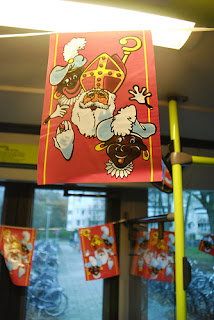
While combing the Leidsestraat and other commercial avenues, I kept coming across the same picture. There were many variations, but they all included a Santa Claus crowned in a papal hat. Attending him were boisterous black faces with plumed kangaroo hats, enormous golden earrings and inflamed red lips. It was a caricature of the most minstrel variety, the sort of thing that would give Spike Lee a cerebral aneurysm (see below).


Flabbergasted, I asked Natasja van de Weg--one of my gracious hosts--what was going on. She explained that in the Netherlands, Sinterklaas comes from Spain in a steam boat. But Sinterklaas isn't Santa Claus--he's actually Saint Nicholas. When he arrives, an army of so-called "Black Petes" deliver the presents on his behalf. (The famously pragmatic Dutch are not so incredulous as to believe that St. Nick could deliver all the presents himself). Black Pete is a trickster who delights in passing judgment on the children. The good ones get presents; the bad ones get thrown in a burlap sack and shanghaied to Spain. And that, my friends, is St. Nick--Dutch style.

I protested: everyone knows that Santa Claus resides in the North Pole and drives a team of flying reindeer. Then I realized that the American Santa Claus is perhaps even more absurd; besides, this was Saint Nick we were talking about. But the more I learned about Black Pete, the worse it got. First of all, it is problematic on a number of levels to have a horde of black men indentured to a fat white guy. It's not culturally sensitive. There is, apparently, some less loaded historical resonance: Piet is black because he is Moorish, and the Moors conquered Spain which, in turn, conquered the Netherlands. But he is also black because he climbs down chimneys. As we know, Dick van Dyke wore a permanent smudge as a chimney sweep in Mary Poppins. This knowledge has inspired legions of Dutch people to daub their faces with black grease and take to the streets in a riot of racially-charged Yuletide cheer.

I asked around for Zwarte Piet hot spots on the 5th of December, the day of gift-giving. It turned out that these festivities are mostly private and children-oriented. Plus, Black Pete is most in evidence in late November when he arrives by boat.

Dejected, I returned to my hotel room and turned on the television. For a moment I thought I was hallucinating: there on the screen was a swarm of children in black-face and harlequin dress doing gymnastics. Some walked precariously on balance beams, others vaulted through the air. One pranced around with a ribbon the color of his obese crimson lips. The scene changed; now they were climbing jungle gyms and gallivanting on grassy fields. "This is just messed up," I said to myself. As if in response, the audio track switched to obscene giggling. The camera panned out, and now the politically incorrect children were gadding about on the belly of the purple Teletubby!

It was all too much. I changed the channel. In front of a Swiss mountain backdrop stood the most Aryan-looking German possible. A scarf wrapped around his neck and a twinkle in his eye, he was singing what else but "What a Wonderful World."

Labels:


03 December 2006

The First 24 Hours in Amsterdam

During my first two days in Amsterdam, I ranged far and wide through the city, mostly on account of misfortune. No sooner was I expulsed from the hubbub of Centraal Station did I find myself confronted by Damrak's gaudy array of sex shops, tacky curios, English style breakfasts and careening trams. A steady downpour lent the cobbled streets a dour air. I wanted nothing more than to abscond to my hotel and swaddle myself in a down comforter, but check-in wasn't until 2pm. It was seven in the morning.

Still, there was a spring in my step. Coming from three straight years in the insular state of Wisconsin, here I was in a real, cosmopolitan city. It was a decidedly non-American city--not a loose patchwork of ethnic neighborhoods; from the gabled roofs to the lapping canals, it was unmistakably Dutch, owing in no small part to an historical advantage of some five hundred years. And it was conspicuously cosmopolitan: every variety of human being is abundantly present in Amsterdam where less than half the population is ethnically Dutch. French, German, English, Arabic and Nederlands coursed through the air of Damrak along with heavy plumes of hash smoke.

It was not long before I became acquainted with the inner-workings of this city reclaimed from the sea. The latticework of canals and dams that keep Amsterdam afloat contributes to an irregular network of streets. As I was to find out the hard way, the avenues of Amsterdam radiate from the Ij River so confusingly that they are utterly incomprehensible on the ground.

It was into this incomprehensibility that I wandered. Neurotically loath to ask for directions lest I mark myself a boorish American halfwit, I pigheadedly marched into the unknown--and the unknown I certainly found. My morbid self-awareness multiplied with the sight of every immaculately dressed European, as did my taboos. Soon I refused to even glance at my map, and soon I was despicably lost. I had only my camera with me, and I used it with the desperation of a man destined for the gallows, taking refuge in scribbling his final thoughts (see below).

One moment I was in the lovely plaza of De Spui (pronounced De Shpye). The next found me stranded between canals. Soon I was wandering through a warren of markets, then over what appeared to be a highway, an industrial zone, a park, an alleyway saturated with marijuana smoke, a gay bondage shop, an upscale shoe store, and finally the same park as before.

7am turned to 6pm as I stumbled hysterically back to the Centrum. My otherwise reliable Vasque boots were in tatters with the left one now bereft of a sole. My feet were blistered and throbbing, my mind mishmashed, my dignity stripped and my confidence crippled. As a fortuitous turn brought me to the facade of Hotel Luxer, I felt a kind of spiritual rapture known only to the religious pilgrim who, after a journey of great peril, throws himself madly to the ground and passionately kisses it. I finally had my hotel, my bed, and my sleep.

I woke early the next morning for the free "continental" breakfast. The fecundity of the continent is such that it circumscribes a full two types of bread, sandwich meat, hard boiled eggs, and donuts. Eager to sate myself, I found the entire self-serve counter blockaded by a scrawny white boy with a brain-fried look on his face and a Nike shirt--my first American! Though there was ample seating available in the form of twelve empty tables, my compatriot stood at the counter shoving donuts into his mouth.

"Excuse me," I said.

He turned to me, his mouth ringed with crumbs, a strand of spittle suspended to a withdrawn donut, and replied,

"Uhh."

I collected my food and sat down. I glanced at him periodically as my disbelief gave way to expectation--surely the present donut would meet the same fate as all the others: half-eaten and redeposited on the counter.

Suddenly, a maid appeared to replenish the supplies. She looked askance at the Braindead American. He turned to her. Slowly, he lifted his donut-hand with zen-like disinterest. Their eyes met. I sat riveted as he blubbered,

"What's this?"
"Dat," she replied, "is a donut."

He looked satisfied, then frightened. He pointed to the coffee-maker.

"What's this?"
"Eet is making the koffie."
Then he pointed to a specific button.
"What's this?"
"Dat is the button for the koffie."

Improbably, he continued:
"What's this?"
"Dat is the button for cappuccino."

He pointed to each of the twelve buttons--clearly marked in English and Dutch--and asked the same question. Satisfied with his mastery of the bewildering coffee maker, he turned his attentions to a pitcher of orange juice, then milk. The maid, exasperated, said,

"Dat is milk, the same color in America, no?"
"Uhh."
"Why don't you sit down?"

I finished my breakfast and left. One last glance confirmed my suspicions: a pile of half-eaten donuts lay scattered on his table.

I have never felt less patriotic.

Labels: